

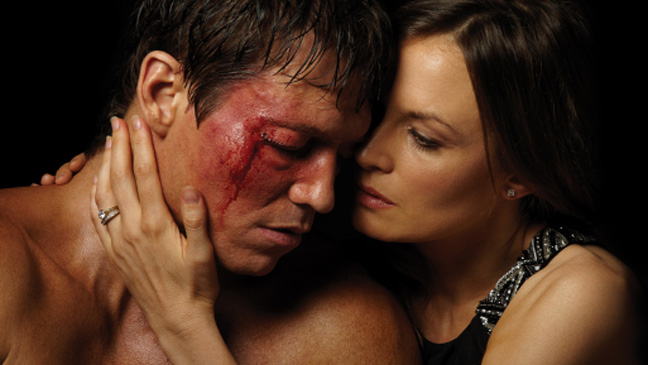
After 13 episodes, FX’s Lights Out has come to an end. With news coming out a few weeks back that FX wouldn’t pick up a second season, fans of the show will have to be satisfied with just one season delving into the life of the 40-year-old comebacking heavyweight Patrick “Lights’ Leary.” After several months of shows, did last night’s series finale of Lights Out deliver?
The show had spent the last four episodes in a “treading water” phase. The shows were for the most part self-contained mini-storylines that weren’t essential to moving the series forward: Lights briefly hiring the eccentric trainer Ed Romeo, the re-appearance of Lights’ mother, the appearance of shot fighter Jerry “The Rainmaker” Reyes, and the FBI investigation into Lights’ bagman work. What they did display is how so many outside issues can hurt a boxer’s performance in the ring.
The most interesting thing about this was a roundtable discussion that featured several real-life boxers like Paulie Malignaggi, John Duddy and Vivian Harris. Helmed by mobster Hal Brennan, the sitdown was done for the possibility of everyone coming together to start their own promotional company, United Boxers, to run the ruthless promoter Barry K. Word out the game. Their reasons revolved around how fighters were getting raped out of their money. For example, one fighter signed to Word disclosed how he his championship fight purse of $2.2. million got wilted down to $92,000 after expenses.
Lights Leary was asked to be the face of the organization should he win the championship against Richard “Death Row” Reynolds. He agreed as along as everyone was willing to contribute 10% of their future purses to a boxer’s health fund. Considering his own potential declining health due to pugilistic dementia, it was a prescient decision.
We get a few more side stories before the big fight revolving around a testy meeting between the wives, and Barry K. Word disclosing to Lights that his first comeback opponent, Javier Morales, took a dive on behalf of Brennan. Aside from the knockdown looking suspect, the other clue was a look Brennan and Morales gave each other before the deciding round. Lights’ confidence is of course shaken, but his father reinforces his self-belief just moments before they hit the ring (“We’re not going to let this go to a decision this time. This time these (fists) are your judges.”).
Being that the entire series has led to Leary vs. Reynolds, the actual boxing match gets over 20 minutes of screen time. Boxing is the hardest sport to realistically portray in Hollywood, and some of the same problems we’ve seen before are present here (constant wild haymakers, dramatic punching sounds). Lights takes such a bad beating in the first round it’s hard for a boxing fan to suspend disbelief that any ref would have let it continue. He gets dropped twice, loses a point for clinching, and spends much of a round lifeless on the ropes with his hands down getting teed off on. One knockdown even had him getting knocked through the ropes ala Marciano-Louis. After just one round, Leary in a 10-6 hole.
Lights roars back in the second by making it an ugly, inside fight. We see that the ref is obviously crooked; he ignores a knockdown LEary scored and breaks the action on several occasions to give Reynolds time to recover. Fight fans with a sense of history probably got a kick out of Leary replicating the rope-a-dope down to whispering trash talk into Reynold’s ear when they clinched.
Reynold was down by the end of the round and taking a life-threatening beating. The ref gave him an extremely slow count that only served to prolong the beatdown. Lights showed compassion and held back a few punches as his rival’s corner threw in the towel.
Our hero has won, but we find out very quickly he’s paid a huge price for his victory. After the fight we see him wandering aimlessly, unable to focus well enough to make it down the hallway to his press conference. He ends up in a janitor’s closet, recalling the same place Lights gave a speech earlier in the season to contender Omar “The Assassin” (“You can’t be afraid of the dark. You have to be ready for it.”). When his wife finds him, the full scope of the tragedy is revealed; Lights cannot even remember winning the fight. He’s regained the title, saved his family from financial ruin, and redeemed a haunting defeat that hung over his career. The pound of flesh (his health, memory) has now been received as collateral.
And so ends the tale of Patrick “Lights” Leary. Overall, Lights Out was a very good representation of the world of boxing. While it’s sad to see it go, having a show revolve around the comeback of a 40-year-old heavyweight doesn’t realistically scream longevity. If anything, continuing it would only work by showcasing the downward spiral that happens to all fighters who hang around too long. And that’d be way too depressing.
Kudos to FX and the entire Lights Out cast for their work.

 Beats, Boxing and Mayhem